SEO in 2026 still comes down to three things. Search engines must be able to crawl and index your pages. Those pages must match what people are looking for. And the content must offer something a reader can’t get from a dozen near-identical pages. However, what has changed is where that work pays off. As a result, Google’s AI Overviews and AI Mode, ChatGPT search & Microsoft Copilot now answer many questions before anyone clicks, so visibility increasingly means being cited as well as ranked. Meanwhile, measuring that visibility takes some new tools.
How to read the labels in this guide: Fact means a platform or primary source documents it. Research finding means a study found it, with limits noted. Analysis means our interpretation of the evidence. Prediction means a forward-looking guess..
The short version
- Fact: Google’s guide to optimizing for generative AI features says that optimizing for its AI features is still SEO.
- Fact: To appear in those features, Google must index a page and consider it eligible to show a snippet. However, Google says inclusion is never guaranteed.
- Research finding: Studies disagree on how much AI answers reduce clicks, and the answer depends on the query type and how you measure.
- Analysis: In practice, several popular “AI search hacks” are things Google says you don’t need to do.
What Changed in Search in 2026
A 2026 Timeline
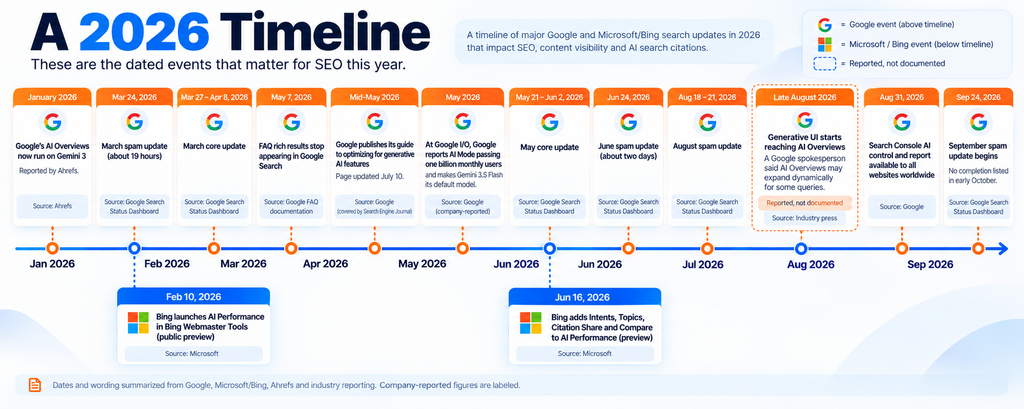
First, these are the dated events that matter for SEO this year.
| Date (2026) | What happened | Basis |
|---|---|---|
| January | Google’s AI Overviews now run on Gemini 3 | Reported by Ahrefs |
| Feb 10 | Bing launches AI Performance in Bing Webmaster Tools (public preview) | Microsoft |
| Mar 24 | March spam update (about 19 hours) | Google Search Status Dashboard |
| Mar 27 – Apr 8 | March core update | Google Search Status Dashboard |
| May 7 | FAQ rich results stop appearing in Google Search | Notice on Google’s FAQ documentation |
| Mid-May | Google publishes its guide to optimizing for generative AI features (page updated July 10) | Google; coverage by Search Engine Journal |
| May | At Google I/O, Google reports AI Mode passing one billion monthly users and makes Gemini 3.5 Flash its default model | Google (company-reported) |
| May 21 – Jun 2 | May core update | Google Search Status Dashboard |
| Jun 3 | Google announces a Search Console report and control for generative AI features | |
| Jun 16 | Bing adds Intents, Topics, Citation Share and Compare to AI Performance (preview) | Microsoft |
| Jun 24 | June spam update (about two days) | Google Search Status Dashboard |
| Aug 18–21 | August spam update | Google Search Status Dashboard |
| Late August | Generative UI starts reaching AI Overviews (Search Engine Journal). A Google spokesperson said AI Overviews may expand dynamically for some queries. | Reported by industry press, with no Search Central documentation |
| Aug 31 | The Search Console AI control and report are available to all websites worldwide | |
| Sep 24 | September spam update begins. It had no completion listed in early October. | Google Search Status Dashboard |
AI Overviews vs AI Mode
| AI Overviews | AI Mode | |
|---|---|---|
| What it is | An AI-generated summary with links, shown on the regular results page | A conversational search experience for complex questions and follow-ups |
| Reach (Google-reported) | More than 2.5 billion monthly users | More than 1 billion monthly users |
| Model | Gemini 3 (per Ahrefs, January 2026) | Gemini 3.5 Flash default (per Google I/O) |
| Connection | Users can ask a follow-up from an overview and continue in AI Mode |
Google describes how these features work in its AI features and your website documentation. For example, Google has offered AI Mode in India since 2025, including in Hindi. If you do Google AI Overviews SEO and AI Mode SEO as separate projects, you’ll duplicate effort. Google says both are built on its core Search systems.
Query Fan-Out: Why One Search Becomes Many
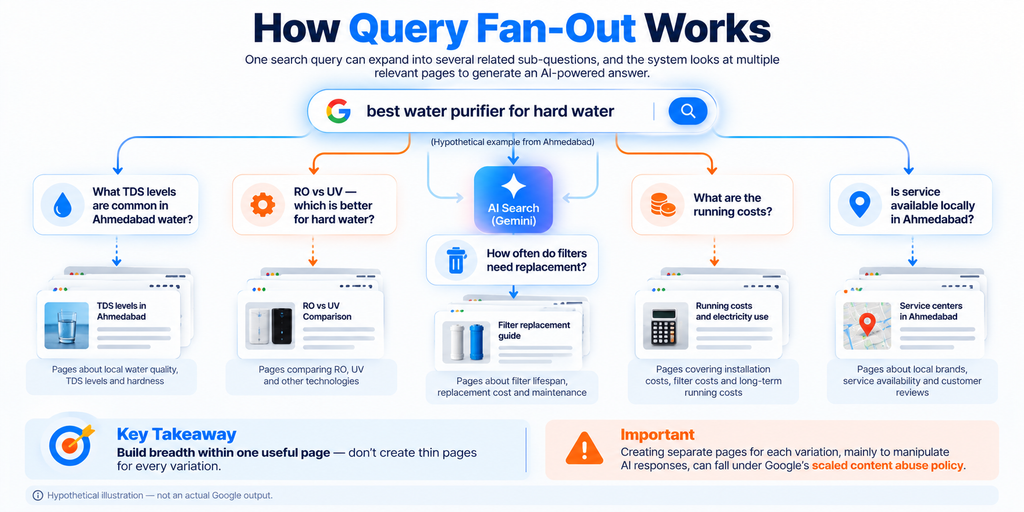
Fact: Google says its AI features use retrieval, meaning they pull content from the Search index, and a technique called query fan-out. Instead of looking up only the words typed, the system runs several related searches at once. Google’s own example in its AI optimization guide: a question about fixing a weedy lawn can trigger searches on herbicides, chemical-free removal and prevention.
Is SEO Still Worth It in 2026? GEO vs SEO vs AEO
Short answer: yes, for most businesses whose customers search. However, “worth it” now depends on measuring the right things.
Research finding: Previsible’s July 2026 study of 166 Google Analytics 4 properties found AI-assistant referrals growing about 9.9 times in 19 months, reaching roughly 645,000 sessions a month in the sample by May 2026. However, the same study found those referrals were a small fraction of total sessions, ranging from about 0.08% for publishers to 1.71% for small and medium businesses. It excluded Google AI Overviews, which don’t produce trackable referral sessions in the same way. Previsible is a consultancy, and its sample isn’t representative of every site.
| Term | What people usually mean | Practical overlap |
|---|---|---|
| SEO | Earning visibility in search engines | The foundation for everything else |
| AEO (answer engine optimization) | Shaping content so it can serve as a direct answer, whether in snippets, voice or AI answers | Mostly clear writing and intent matching |
| GEO (generative engine optimization) | Appearing in answers from generative AI tools | Mostly the same fundamentals plus platform-specific access and measurement |
Fact: Google’s guide says that, from its perspective, optimizing for generative AI search is still SEO. Microsoft uses the term GEO in its Bing Webmaster blog and describes its AI Performance report as an early step in that direction.
Analysis: In the GEO vs SEO debate, the practical read is that AEO and GEO are labels for outcomes, not replacements for search engine optimization. Google’s position covers Google. Other platforms publish less, so what works there is less certain.
What the Click Data Says (and Why Studies Disagree)
Zero-click and click-through studies
| Study | Data | Finding | Limits |
|---|---|---|---|
| SparkToro / Similarweb (June 2026, via Search Engine Land) | US Google searches, Jan–Apr 2026 | 68.01% ended without a click, up from 60.45% in 2024 | US only. Panel data with a mobile/desktop assumption. Excludes Google’s mobile app. |
| Seer Interactive (April 2026) | 53 brands, 5.47M queries, 2.43B organic impressions | Organic CTR on queries showing an AI Overview fell to 1.31% in December 2025, then rose to 2.36% in February 2026. Queries without an overview were at 3.82%. | Directional. Brand cohort, not a random sample. Seer says it can’t claim causation. |
| Pew Research Center (March 2025 data) | 900 US adults, 68,879 searches | 8% of visits with an AI summary included a click on a regular result, versus 15% without | Older snapshot. Short window. |
Research finding, in plain terms: In other words, these studies aren’t contradicting each other so much as answering different questions. Zero-click share asks how many searches end without any click. Click-through rate asks what share of impressions earn clicks on a given set of queries. Pew watched real people browsing. Seer analysed brand search data.
Analysis: Therefore, treat any single percentage as one lens, not a verdict. Seer itself says to use your own data as the main input.
Which searches are most exposed to AI answers
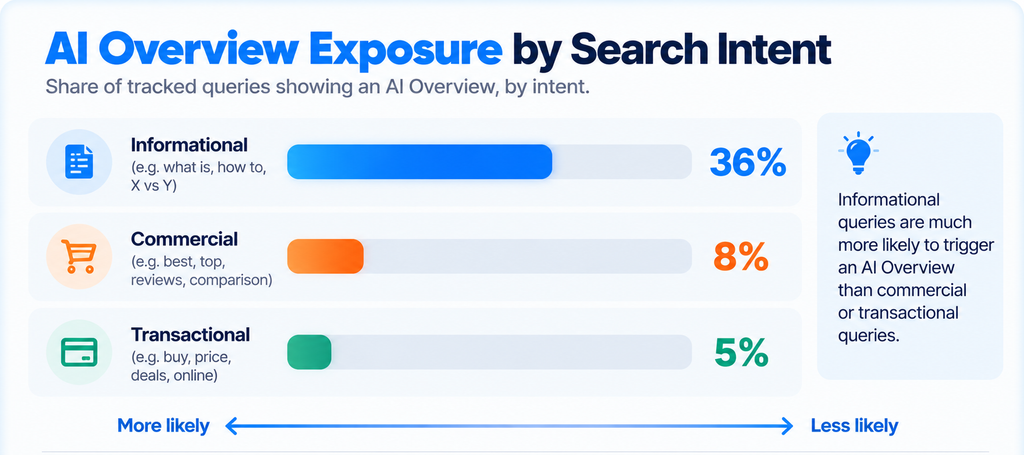
Research finding: In Seer’s cohort, AI Overviews appeared on 36% of informational queries, 8% of commercial queries and 5% of transactional queries. Among tracked informational queries, comparison (“X vs Y”) queries triggered one 95.4% of the time and question-style queries 85.9%.
Citations vs traffic
Research finding: For informational queries in Seer’s data, 1 million impressions produced roughly 33,500 organic clicks with no AI Overview, about 20,743 when an AI Overview cited the brand and about 9,445 when it did not. Even so, a citation can help, but it didn’t restore pre-AI click levels. Seer also found citation counts can rise while click-through rate falls, because impressions grow faster than clicks.
Meanwhile, Bing’s report tells you how often you were cited, not how many people clicked. Google’s report works similarly for impressions. Therefore, don’t read either as a traffic forecast.
How to Rank on Google in 2026
Start with search intent
Before writing, first check what Google currently shows for the query. That tells you whether people want a guide, a comparison, a price or a local business. Our guide to [search intent and keyword research](INTERNAL LINK: Search intent / keyword research) goes deeper.
Hypothetical example: A home interior studio in Ahmedabad might see three different intents. “Interior designer Ahmedabad” is local and commercial. “2BHK interior cost Ahmedabad” is a research query. “Modular kitchen vs carpenter-made” is a comparison. For example, one page can’t serve all three well, so each deserves its own focused page.
Publish non-commodity content
Fact: Google says unique, “non-commodity” content is likely the most influential factor in its AI optimization guide, meaning content that readers won’t easily find in many similar versions elsewhere.
Hypothetical example: A chartered accountant’s “5 tips for GST registration” repeats what dozens of sites say. A page that includes the actual document checklist the firm gives clients, and the mistakes that commonly delay applications, gives readers something distinctive. The firm should describe real practice rather than invent it. Ultimately, good content marketing builds on what the business knows firsthand.
Get the technical basics right
Fact: For Google’s AI features, Google must index a page and consider it snippet-eligible. Check that important pages are crawlable, indexed, load their main content reliably and aren’t blocked by restrictive snippet settings you didn’t intend. Our technical SEO guide covers the checks.
Show expertise and sources
Google’s helpful-content guidance uses experience, expertise, authoritativeness and trust as a lens. In practice, More importantly, that means named authors with real credentials, first-hand detail, cited sources and honesty about limits. Our explainer on E-E-A-T covers how to show each.
Local and e commerce considerations
Fact: Google’s guide points businesses to Google Business Profile and Merchant Center for local and product information, and Microsoft recommends Bing Places for the same reason. Analysis: A wrong opening time or out-of-stock price in these profiles can undermine good content. For a city-focused business, local SEO basics are still the first job.
How to Get Cited in AI Search
Google AI Overviews and AI Mode
Fact: There’s no separate submission process. Be indexed, be eligible for snippets, and make sure your site hasn’t been excluded from generative AI features in Search Console.
Research finding: Ahrefs’ March 2026 study of 863,000 keywords and about 4 million cited URLs found roughly 38% of AI Overview citations also ranked in the top 10 for the same keyword. Its July 2025 study found about 76%. Ahrefs points to query fan-out and the move to Gemini 3 as likely factors, and says its own detection improved.
Analysis: Therefore, ranking well is useful but doesn’t reliably predict citation. Covering the follow-up questions around a topic may matter more than a marginal rank gain.
ChatGPT Search: how to get cited by ChatGPT
Fact: OpenAI’s crawler documentation says OAI-SearchBot is the crawler that surfaces sites in ChatGPT search. If you block it, your site won’t appear in ChatGPT’s answers, though it can still show up as a navigational link. GPTBot is a separate crawler for training, and OpenAI does not use ChatGPT-User to determine Search appearance.
As a result, you can make different choices for search and training. OpenAI’s crawler names and behavior can change, so check its current documentation before editing robots.txt.
Research finding: Previsible found about 28.8% of ChatGPT’s referral traffic in its sample landed on internal site search pages, which suggests ChatGPT often trusts a domain without picking the right page. Analysis: Clear navigation and a working site search help.
However, no verified method guarantees a ChatGPT citation. Because no single tactic can guarantee inclusion, allow the right crawler, keep pages indexable, and write specific, accurate content.
Microsoft Copilot and Bing
Fact: Microsoft says Bing respects robots.txt and other supported controls. It suggests clear headings, tables, FAQ sections, supporting evidence, fresh content, IndexNow for update notifications and Bing Places for local details.
Research finding: In Previsible’s sample, Copilot referral sessions fell about 96% from their August 2025 peak to 339 in May 2026. Analysis: Copilot visibility data is useful for understanding citations, but it isn’t a reliable traffic forecast.
Documented vs suggested by research
| Level | Examples |
|---|---|
| Documented by platforms | Google: indexed, snippet-eligible, included in AI features. OpenAI: OAI-SearchBot access. Microsoft: robots.txt, IndexNow, structure suggestions. |
| Research suggests | Top-10 rank doesn’t reliably predict AI Overview citation (Ahrefs). Sites with working internal search may capture ChatGPT referrals better (Previsible). |
| Unproven | Any specific tactic that guarantees citation |
AI Search Myths: Claim vs Evidence
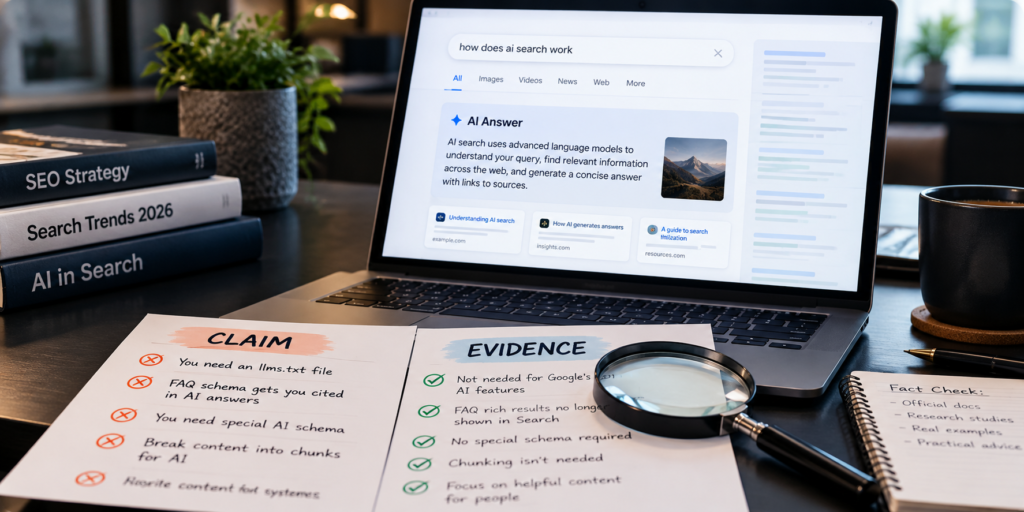
| Claim | What Google documents | Other notes | Practical verdict |
|---|---|---|---|
| “You need an llms.txt file” | Google says it’s not needed for its AI features | Other platforms haven’t documented requirements in the sources we reviewed | Don’t prioritize it |
| “FAQ schema gets you cited in AI answers” | FAQ rich results stopped appearing in Google Search on May 7, 2026. Google says no special schema is needed. | Microsoft suggests FAQ sections as content, not markup | Write FAQs for readers if useful. Don’t add markup expecting AI citations. |
| “You need special AI schema” | Google says no special schema is needed | Standard structured data still serves its normal purposes | Use schema where it fits the content type |
| “Break content into chunks for AI” | Google says chunking isn’t needed | Microsoft suggests clear headings and tables | Write clearly for people |
| “Rewrite content for AI systems” | Google says AI-specific rewriting isn’t needed | Improve content for readers | |
| “Farm mentions across the web” | Google lists seeking inauthentic mentions as unnecessary | Real reputation and reviews are different | Earn real mentions, don’t manufacture them |
| “Create a page for every fan-out query” | Google warns this can be scaled content abuse | One thorough page per intent |
Google’s guide covers Google. Other platforms publish less, so “unproven” doesn’t mean “proven false.”
How to Measure SEO in 2026
Google Search Console. Start with the standard Performance report for clicks, impressions and queries. For example, if you’re new to Search Console, see our Google Search Console walkthrough.
Search Console generative AI report. Fact: Google’s Generative AI performance report shows impressions and pages for AI features, uses Web search type data and has the usual 1,000-row limit. You can use it, for example, to see which pages appear in AI features. However, don’t compare its numbers directly with the standard report. Google’s guide also cautions that third-party tools can’t see Google’s internal data.
Bing AI Performance. Fact: It shows total citations, average cited pages, grounding queries, page-level activity and trends. Since June 16, previews include Intents, Topics, Citation Share and Compare. However, Microsoft says the data is a sample and doesn’t indicate ranking or placement within an answer.
Analytics. In GA4, create a view of sessions from chatgpt.com, gemini.google.com, perplexity.ai, copilot.microsoft.com and claude.ai. Previsible recommends tracking by page type, because site-wide averages can hide where AI traffic lands. Analysis: Some AI-influenced visits may show up as direct or branded search, so treat these numbers as a minimum.
Manual checks. Pick 10–20 questions your customers actually ask. Run them in Google (including AI Mode), ChatGPT and Copilot. Note whether you’re cited, whether the answer is accurate, and who is cited instead. Repeat monthly. AI answers can change over time, as Pew noted, so a single check proves little.
Should You Opt Out of Google’s AI Features?
Fact: Google’s Search Console control lets you opt out of generative AI features. Google says opted-out sites get no traffic or impressions from them, and that the control isn’t used as a ranking signal outside those features.
Analysis: The trade-off is simple. Opting out may protect content you don’t want summarized, but it removes you from a growing share of search results. For most businesses whose goal is visibility, that cost is high. Reasons to consider it include licensing concerns or content that loses value when summarized. If you’re unsure, stay in and measure first.
A Practical SEO Plan for 2026
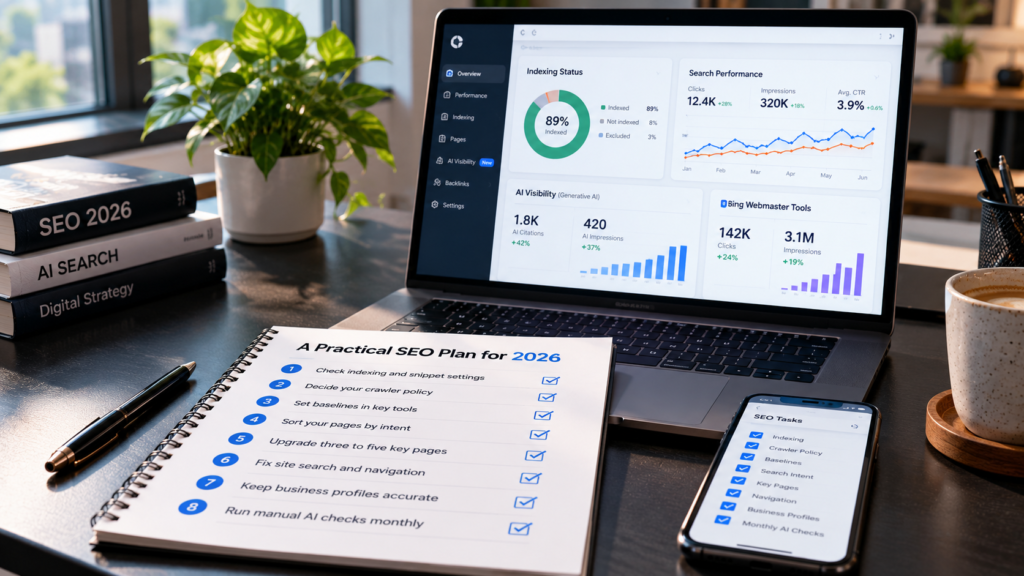
- Check indexing and snippet settings on your ten most important pages.
- Decide your crawler policy. Know what you’re allowing for Google bot, Bingbot, OAI-SearchBot and GPTBot.
- Set baselines in Search Console, the generative AI report and Bing Webmaster Tools.
- Sort your pages by intent. Mark which are informational, commercial or transactional, and note which show AI exposure.
- Upgrade three to five key pages with first-hand detail, clearer answers to follow-up questions and named authors.
- Fix site search and navigation so visitors from any source can find the right page.
- Keep business profiles accurate in Google Business Profile, Merchant Center and Bing Places.
- Run manual AI checks monthly and compare against your baselines.
If you want a second pair of eyes on an audit, that’s the kind of work covered by Ad Pe Charcha’s SEO services
Common Mistakes
- Treating AEO and GEO as separate jobs. Most of the work overlaps with good SEO.
- Publishing at scale. Google’s scaled content abuse policy targets pages made mainly to manipulate search.
- Blocking crawlers by accident. A blanket robots.txt rule can remove you from AI search.
- Reading AI reports as traffic. Citations and impressions aren’t visits.
- Judging by one study. Read the method before the headline.
- Panicking after every update. If traffic moves around a core or spam update date, compare like-for-like periods before changing anything. Google lists update dates on its Search Status Dashboard.
- Ignoring the queries AI doesn’t answer. Transactional and low-exposure queries are where clicks held up best in Seer’s data.
FAQs
Is SEO dead because of AI search?
No. Google says optimizing for its AI features is still SEO, and studies show click patterns changing, not disappearing. What has changed is that being cited can matter alongside being clicked.
What’s the difference between SEO, AEO and GEO?
SEO is the broad discipline. AEO usually means shaping content for direct answers, and GEO usually means appearing in generative AI answers. In practice they overlap heavily.
How do I get my content into Google AI Overviews?
Be indexed and snippet-eligible, publish distinctive content, and make sure your site is included in generative AI features in Search Console. Google doesn’t guarantee inclusion.
Does llms.txt help?
Google says it isn’t needed for its AI features. We found no verified evidence that other platforms require it.
How do I get cited by ChatGPT?
Allow OAI-SearchBot in robots.txt, keep pages indexable and write specific, accurate content. No verified method guarantees a citation.
How do I see AI Overview impressions in Search Console?
Use the generative AI performance report, which shows impressions and pages for AI features. Check your own account to see what it includes.
Do I need to rank in the top 10 to be cited?
Not necessarily. Ahrefs found about 38% of AI Overview citations came from top-10 pages in its March 2026 study, so ranking helps but doesn’t decide it.