AI SEO isn’t just about asking ChatGPT to write a blog post. It is about using AI to make SEO work more efficient while also preparing content for the AI-powered search experiences people increasingly use to find information.
In other words, AI SEO is the use of artificial intelligence to support search engine optimization. The term also gets used for a second job: making your content visible in AI-powered search, such as Google’s AI Overviews and AI Mode, ChatGPT search and Microsoft Copilot. The two are related but not the same, and separating these two meanings makes the topic easier to understand.
This guide separates them, shows where AI helps across an SEO workflow, flags the tasks you shouldn’t hand over completely, and explains how to measure results. It relies on official documentation rather than vendor claims, and it contains no invented statistics.
What Is AI SEO?
AI SEO is not an official discipline with its own rulebook. It’s a working label, and people use it in two ways:
- Using AI to improve SEO. AI tools assist with research, analysis, drafting, optimization and reporting.
- Optimizing for AI-powered search. Making sure your content can be found, understood and cited where AI generates answers.
Either way, the underlying work is still SEO: understanding what people search for, publishing something genuinely useful, and making sure search engines can crawl and index it. AI changes how quickly some of that work gets done and where some results appear. It doesn’t change what makes a page worth surfacing.
Why Is AI Becoming Important in SEO?
Two shifts happened at the same time.
Search results now include AI-generated answers. Google says AI Overviews and AI Mode can use “query fan-out”: running several related searches across subtopics and data sources to build one response. Its optimization guide also acknowledges that people are increasingly turning to generative AI experiences to find information. OpenAI’s OAI-SearchBot surfaces sites in ChatGPT search, and Microsoft reports citations in Copilot and AI-generated summaries in Bing.
SEO workflows are full of tasks AI handles well. Sorting thousands of queries, summarizing competitor pages, auditing titles and drafting reports are repetitive, pattern-heavy jobs. A language model can produce a useful first pass in minutes.
Importance isn’t a guaranteed payoff, though. Nothing in Google’s documentation says that using AI improves rankings.
Two Meanings of AI SEO: Using AI vs. Optimizing for AI Search
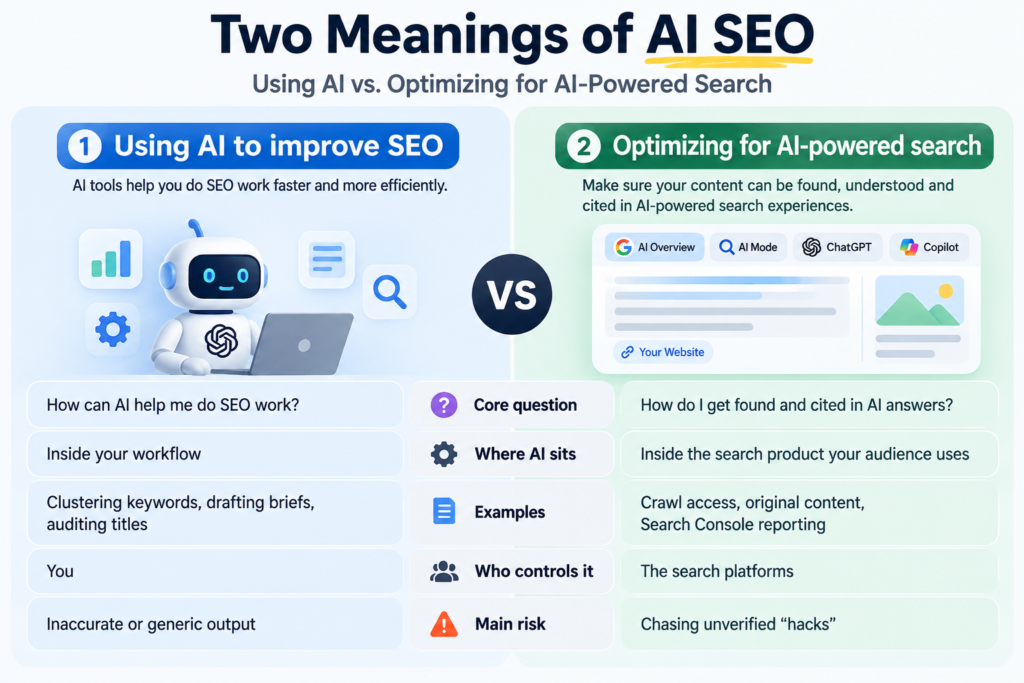
| Using AI to improve SEO | Optimizing for AI-powered search | |
|---|---|---|
| Core question | How can AI help me do SEO work? | How do I get found and cited in AI answers? |
| Where AI sits | Inside your workflow | Inside the search product your audience uses |
| Examples | Clustering keywords, drafting briefs, auditing titles | Crawl access, original content, Search Console reporting |
| Who controls it | You | The search platforms |
| Main risk | Inaccurate or generic output | Chasing unverified “hacks” |
Google’s guidance is the clearest on the second meaning. From its perspective, optimizing for generative AI search is optimizing for the search experience, so it’s still SEO. To appear as a supporting link in AI Overviews or AI Mode, a page must be indexed and eligible to show in Search with a snippet. Google also says there’s no special schema.org markup you need to add.
The two meanings overlap, but you can do one without the other. A team can use AI at every step and still publish pages no AI answer ever cites. A site that has never touched an AI tool can be cited often because its content is original and its technical basics are sound.
AI-Generated Content Is Not AI SEO
AI-generated content ≠ AI SEO. Treating them as the same thing is the most common mistake in this space.
- SEO is much wider than writing. It covers research, site structure, crawling and indexing, internal links, page experience and measurement. A model can draft text. It can’t decide which topics fit your business or fix a crawl problem on its own.
- Mass production can break Google’s spam policy. Google says generative AI is useful for researching a topic and adding structure to original content. But using it to generate many pages without adding value for users may violate the scaled content abuse policy.
- AI output is not a source of truth. Models can produce plausible but incorrect information, so treat what they write as a draft, not a reference. Verify important claims against reliable primary sources before publishing. Google recommends manually fact-checking AI output, including titles, meta descriptions, structured data and image alt text.
- Easy-to-generate content has little to offer. Google’s AI search guide encourages “non-commodity” content, meaning unique, experience-based takes rather than common knowledge a model could produce. Its example contrast is a generic list of homebuying tips versus a first-hand account of a specific decision.
AI is a tool that can assist SEO. It doesn’t create a successful strategy by itself, and no source I reviewed says otherwise.
How AI Can Help Across the SEO Workflow
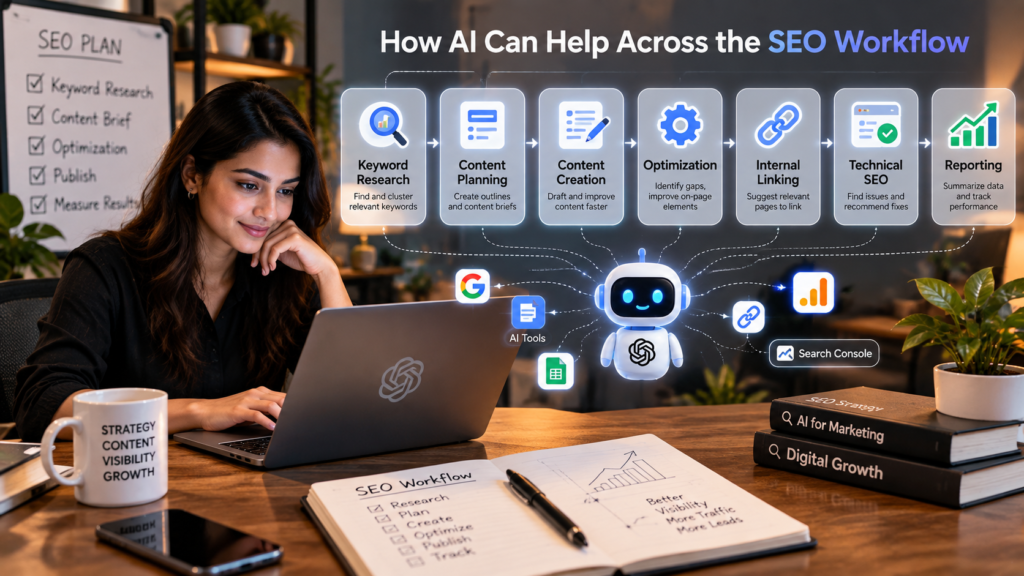
Research and planning
Keyword research. For AI keyword research, AI can expand seed topics, suggest modifiers and phrase questions the way people ask them. One caution: a general chatbot doesn’t have search-volume data unless it’s connected to a keyword tool or Search Console, so take numbers from a real data source.
Search intent analysis. Give AI the titles and formats of the pages ranking for a query and ask it to classify the intent: informational, commercial, transactional or navigational. Then read the actual results yourself. Intent can differ between queries that look nearly identical.
Keyword clustering. AI groups queries by meaning rather than spelling, which beats sorting a spreadsheet by hand. Check the clusters for merged intents, such as “what is” and “best tools” queries sitting together.
Topic research. Google’s example of query fan-out is a person asking how to fix a weedy lawn, which could trigger related searches on herbicides, chemical-free removal and prevention. Asking AI which subtopics a reader will need next is a similar exercise. Google also warns that creating separate pages for every variation primarily to manipulate rankings or AI responses violates its scaled content abuse policy.
Competitor and content-gap analysis. AI can summarize what top pages cover and list questions they leave unanswered. The gap worth filling is usually experience, data or a clearer explanation, not one more heading copied from a rival.
Content
Content briefs. A good brief covers the audience, intent, outline, questions to answer, sources to cite and pages to link. AI assembles the skeleton quickly. You supply the angle and the evidence.
Content creation assistance. AI is useful for outlines, tightening clumsy paragraphs, and turning an expert’s interview notes into a first draft. The expert’s knowledge has to be the input, not the model’s guess.
Content optimization. Compare a draft against the brief to find missing subtopics, repetition and unclear passages. The goal is a more complete answer, not a keyword-density score.
On-page SEO. AI can draft title and meta description options, suggest heading structure and write first-pass image alt text. Review all of it, since this metadata can appear in search results.
Internal linking. With a crawl export, AI can suggest which existing pages are related to a new one. You choose the anchor text and decide whether the link helps the reader. Google lists easy findability through internal links among the fundamentals that still apply to its AI features.
Content refreshes. Pair Search Console data with AI to flag declining pages, outdated claims and thin sections. AI proposes updates. You verify each fact before it goes live.
Technical work and reporting
Technical SEO analysis. AI can summarize large crawl or log exports, group errors by pattern, explain a Search Console report and draft redirect rules or regular expressions. Test anything before it touches a live site.
Schema and structured data. AI can draft JSON-LD quickly. Validate it, make sure it matches visible page content, and follow Google’s structured data guidelines.
SEO reporting and analysis. AI can summarize Search Console exports, annotate trends and draft the narrative of a report. Check its numbers against the source, because models can misread tables.
Which SEO Tasks Should You Use AI For?
A useful rule: use AI for high-volume, pattern-based work where you can quickly verify the output.
| Task | Why AI fits | Your check |
|---|---|---|
| Clustering large keyword lists | Fast grouping by meaning | Review for mixed intents |
| Summarizing SERPs and competitor pages | Saves reading time | Open the real results |
| Drafting brief outlines | Quick structure | Add your angle and sources |
| Title and meta description options | Many variations at once | Accuracy and length |
| Internal link suggestions | Spots related pages at scale | Relevance and anchor text |
| Refresh audits | Flags outdated or thin sections | Verify every replacement fact |
| Summarizing crawl or log data | Handles big exports | Confirm patterns on samples |
| Drafting schema | Speeds up JSON-LD | Validate and match page content |
| Report commentary | Turns data into readable notes | Check numbers against the source |
Which SEO Tasks Should You NOT Fully Automate?
The common thread is judgment, accountability and first-hand knowledge.
- Strategy. Deciding which audiences, topics and business goals to prioritize depends on context a model doesn’t have.
- Fact-checking. Because models can produce confident errors, a person should verify claims, statistics, dates and product details before publishing.
- Original experience. AI can’t have tested the product, handled the client or seen the results. Experience has to come from people. Google’s guidance repeatedly points to unique, first-hand perspective as what stands out.
- Sensitive topics. Google says its systems give extra weight to content that aligns with strong E-E-A-T on topics affecting health, financial stability or safety. Expert review matters most there.
- Final editorial judgment. Tone, accuracy, usefulness and whether a page deserves to exist are editorial decisions.
- Live site changes. Redirects, robots.txt edits, canonical tags and schema deployments should be tested and approved by a person.
The AI SEO Decision Framework
For each stage of the work, this table separates what AI can take on from what a person has to decide.
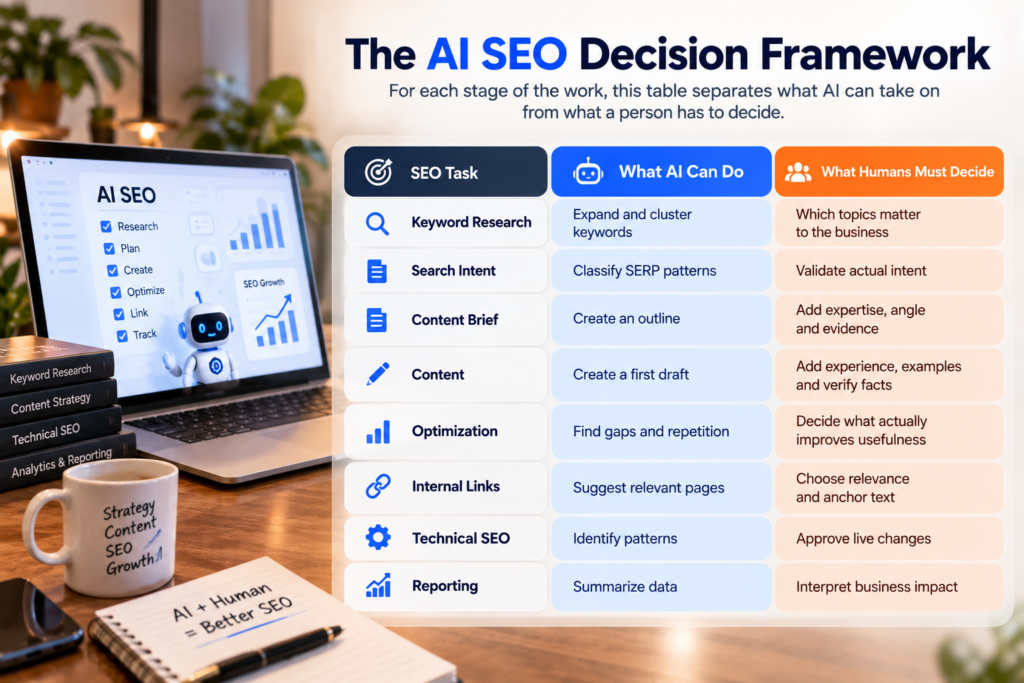
The pattern is the same in every row. AI-assisted SEO is about reducing repetitive work: the grouping, summarizing and first drafts. Humans stay responsible for strategy, accuracy, experience and final decisions. The hours saved are best spent on what differentiates a site: original examples, better explanations and stronger technical upkeep. The fundamentals of crawlability, relevance, quality and usefulness don’t go away.
Example: How an SEO Agency Can Use AI
This is a hypothetical workflow, not a client case study, and the numbers and results are deliberately left out.
Picture an agency onboarding a client that sells invoicing software to small businesses. The workflow looks like this:
Keyword export → AI clustering → Human intent validation → AI content brief → Expert content creation → Human fact-checking → Technical validation → Publishing → Measurement
- Keyword research: Export queries from Search Console and a keyword tool.
- AI clustering: AI groups keywords by meaning and suggests clusters.
- Intent validation: An SEO checks the actual SERPs and separates mixed search intents.
- Content brief: AI creates the outline; the strategist adds the angle, questions and sources.
- Content creation: Experts provide the knowledge; AI helps structure and refine the draft.
- Fact-checking: A human verifies claims, dates, figures and metadata.
- Technical SEO: Check indexing, canonicals, internal links and structured data.
- Publish & measure: Publish after approval, then track traffic, clicks, conversions and AI-search visibility.
The key idea: AI handles repetitive work, while SEO professionals remain responsible for strategy, accuracy, expertise and final decisions.
AI SEO Best Practices in 2026
- Start with search intent. Understand what the searcher actually wants and answer it directly. Intent matters more than keyword counts.
- Create helpful, original content. Add something AI cannot easily generate on its own:
- First-hand experience
- Original examples
- Your own data or insights
- A clear point of view
- Reliable sources and evidence
- Show real expertise (E-E-A-T). Use clear authorship, accurate information, relevant experience and transparent sourcing.
- Build topical relevance. Create connected pages that cover a topic meaningfully instead of publishing large volumes of similar content.
- Use internal links strategically. Connect related pages with clear, descriptive anchor text to help users and search engines discover relevant content.
- Keep technical SEO healthy. Make sure pages are crawlable, indexable and eligible to appear in Search. For AI-powered platforms, also review crawler access such as Google’s and OpenAI’s relevant bot controls.
- Use Search Console’s AI controls carefully. Google provides controls for managing your site’s participation in its generative AI features. Treat this as a visibility setting, not a ranking shortcut.
- Fact-check AI output. Verify claims, statistics, dates, metadata, schema and alt text before publishing.
- Keep humans in the loop. AI can assist with repetitive work, but people should remain responsible for strategy, accuracy, expertise and final approval.
- Avoid mass-produced, low-value content. Creating large numbers of pages without adding real value can create quality and spam-policy risks.
- Ignore unproven AI SEO hacks. Don’t chase tactics such as
llms.txt, excessive content chunking, AI-specific rewriting or artificial mentions simply because someone claims they improve AI visibility. Follow official search-engine guidance instead.
Bottom line: Use AI to make SEO faster—not to remove the human expertise that makes your content valuable.
Common AI SEO Mistakes
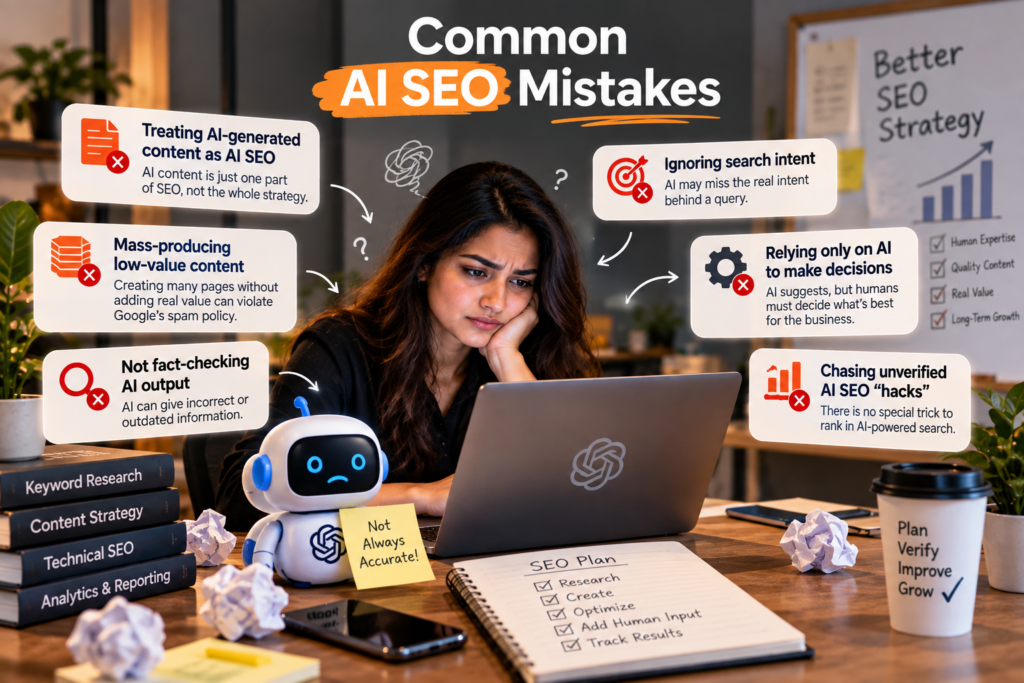
- Publishing raw AI-generated content. Unedited drafts tend to be generic and unverified.
- Trusting inaccurate AI information. Models can state wrong facts fluently. Verify claims against primary sources.
- Keyword stuffing. Repeating a phrase doesn’t make a page more relevant, and AI tools can nudge writers to overdo it. Write naturally.
- Creating generic content. If a page says what every other page says, it gives readers and AI systems no reason to choose it.
- Ignoring search intent. A well-written page that answers the wrong question won’t satisfy the searcher.
- Automating everything. Fully automated pipelines remove the review that catches errors.
- Ignoring technical SEO. Great content can’t help if pages aren’t crawlable or indexable.
- Relying on AI instead of expertise. AI can speed up an expert. It can’t replace one.
How to Measure AI-Assisted SEO
Measure AI-assisted work the same way you’d measure any SEO work.
- Rankings. Track positions for target queries as trends, since results vary by location and device.
- Impressions. How often your pages appeared in results, from Search Console.
- Clicks. Visits from search to your site.
- CTR. Clicks divided by impressions. If it falls while impressions hold steady, look at queries and pages before concluding the content got worse, since the results page itself may have changed.
- Organic traffic. Search-originated sessions in your analytics.
- Conversions. Leads, sign-ups or sales, whatever matters to the business. These show whether the traffic is valuable.
To judge whether AI itself helped, group AI-assisted pages separately and compare them with pages produced without AI over a similar period. This gives you a more useful comparison, although it is not a controlled experiment and does not prove that AI caused the difference.
Measuring AI-search visibility
- Google Search Console. Google says sites appearing in AI Overviews and AI Mode are included in overall Search Console traffic. Its Generative AI performance report, rolled out to all websites worldwide as of August 31, 2026, adds impressions for these features by page, country, device and date. It reports impressions, so pair it with the standard Performance report for clicks.
- Bing Webmaster Tools. Microsoft’s AI Performance report, launched in public preview in February 2026, shows citations across Copilot, AI summaries in Bing and select partners, including cited pages and grounding queries. In June 2026 Microsoft added four preview capabilities:
- Intents: groups citations by the type of query behind them.
- Topics: shows the themes associated with your cited content.
- Citation Share: shows how much of the citation space your site receives for a specific grounding query, not just a raw count.
- Compare: lets you view changes across time periods.
- ChatGPT. The OpenAI documentation I reviewed covers crawler controls rather than a reporting dashboard. Referral traffic in your analytics and crawler activity in server logs are reasonable proxies.
- Third-party trackers. Google cautions that no third-party tool has access to its internal ranking or AI systems. Because AI-generated responses vary, treat tracked-prompt results as samples, not definitive rankings.
The Future of AI SEO
Here’s what the evidence supports:
- AI features are becoming a bigger part of search. Google and Bing both launched AI-specific reporting within months of each other, which suggests platforms expect site owners to need it.
- Fundamentals still carry the weight. Google says its generative AI features are rooted in its core ranking and quality systems.
- Agentic experiences are emerging. Google’s guide points to AI agents, such as browser agents completing tasks for people, and notes emerging protocols that will let search agents do more. Clean, readable pages and a good page experience help.
What’s still unsettled: exactly how much traffic AI answers send, how each platform chooses sources, and which tactics will matter long term. Be skeptical of anyone who claims certainty.
My expectation, which is opinion rather than documented fact: as AI use becomes routine, the advantage will shift to what AI can’t supply, namely first-hand experience, proprietary data and a clear point of view.
The Bottom Line
AI SEO is best understood as two things: using AI to do SEO work more efficiently, and making your content ready for AI-powered search. Both rest on the same foundation of useful content, sound technical health and human accountability. Use AI to remove repetitive work, keep people responsible for strategy, facts and experience, and measure what actually happens.
FAQ
What is AI SEO?
AI SEO is the use of AI to support SEO work such as research, content planning, optimization and reporting. The term is also used for optimizing content to appear in AI-powered search experiences. The two are related but not identical.
Can AI replace an SEO professional?
This is analysis, not documented fact: AI can speed up repetitive tasks, but strategy, fact-checking, first-hand experience and editorial judgment still need people.
How can I make my website eligible to appear in ChatGPT search?
OpenAI recommends allowing OAI-SearchBot in your robots.txt file. Allowing it makes your site eligible to be considered, but it does not guarantee citation or visibility. Sites that opt out won’t be shown in ChatGPT search answers, though they can still appear as navigational links. OAI-SearchBot and GPTBot are controlled separately.
How do I track visibility in AI search?
Use the Generative AI performance report in Google Search Console for impressions in AI Overviews and AI Mode, and the AI Performance report in Bing Webmaster Tools for citations across Copilot and Bing AI summaries. Combine these with your analytics.
Do I need special schema markup or an llms.txt file to appear in Google’s AI features?
No. Google says there’s no special schema.org markup you need for generative AI search, and that Google Search ignores llms.txt files. Structured data remains useful for rich result eligibility.
Does Google penalize AI-generated content?
Google’s guidance focuses on quality and its spam policies rather than on whether AI was involved. Using generative AI to produce many pages without adding value for users may violate the scaled content abuse policy, and Google recommends manually fact-checking AI output before publishing.
Is AI SEO different from GEO or AEO?
GEO (generative engine optimization) and AEO (answer engine optimization) are terms for work focused on visibility in AI search. Google’s guidance says that from its perspective, optimizing for generative AI search is still SEO, and it advises evaluating third-party GEO or AEO advice against its own documentation.
Sources Referenced
- Google Search Central: Optimizing your website for generative AI features on Google Search
https://developers.google.com/search/docs/fundamentals/ai-optimization-guide - Google Search Central: Guidance on using generative AI content
https://developers.google.com/search/docs/fundamentals/using-gen-ai-content - Google Search Central: AI features and your website
https://developers.google.com/search/docs/appearance/ai-features - Google blog: New opportunities, control and insights for website owners
https://blog.google/products-and-platforms/products/search/new-controls-website-owners/ - Google Search Console Help: Generative AI performance report
https://support.google.com/webmasters/answer/16984139 - Bing Webmaster Blog: Introducing AI Performance in Bing Webmaster Tools Public Preview (February 10, 2026)
https://blogs.bing.com/webmaster/February-2026/Introducing-AI-Performance-in-Bing-Webmaster-Tools-Public-Preview - Bing Webmaster Blog: New AI Visibility Insights in Bing Webmaster Tools: Intents, Topics, Citation Share, Compare (June 2026)
https://blogs.bing.com/search/June-2026/New-AI-Visibility-Insights-in-Bing-Webmaster-Tools-Intents-Topics-Citation-Share-Compare - OpenAI Developers: Overview of OpenAI Crawlers
https://developers.openai.com/docs/bots